A flexible solution minimizing recycled fractions and start-up time, achieving the highest purity and FDA compliance.
What
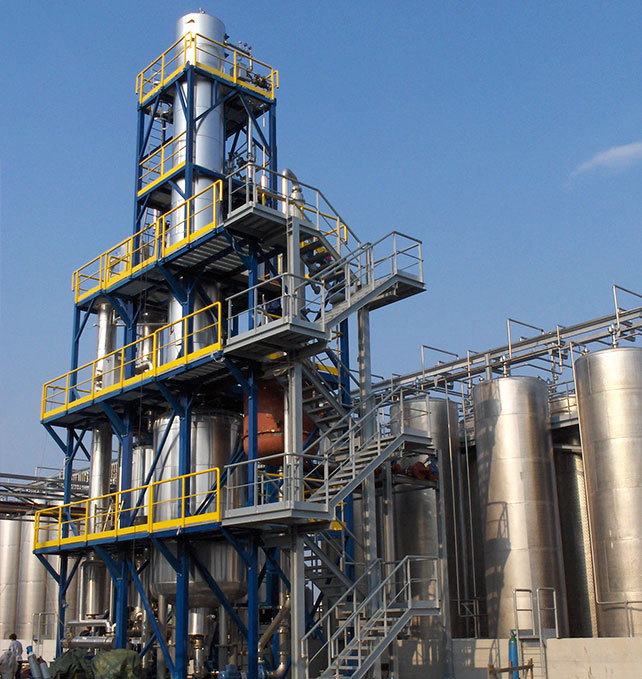
At Polaris, we developed the Internal Reflux Distillation Column, a proprietary technology (covered through an international patent) that combines mass and heat transfer to efficiently separate and purify streams. Thanks to this innovative technology or through more traditional internals, such as trays or structured packing, Polaris can offer complete systems for batch or continuous distillation for different applications.
The proposed technologies are particularly efficient where a high quality distillate is required. Internal Reflux Column is specifically adopted in solvent recovery from complex mixtures, where the results of other available techniques are inadequate or result in an economically inconvenient recovery.
Our plants are versatile, allowing us to design the recovery process according to specific project requirements, on a case by case basis. We have successfully utilized internal reflux distillation for the following processes:
- Distillation at pressures less than, equal to, or more than atmospheric pressure
- Distillation under high vacuum – Azeotropic distillation – Extractive distillation
- De-hydration by distillation with phase separation For each of the above-mentioned processes, it is possible to fractionate with variable or constant internal reflux.
The plant configuration and the recovery method are established depending on the characteristics and quantities of the mixtures to be treated, and on quality specifications defined for the distilled products.
Why
Advantages of the technology
1
Quick start-up
The cooling fluid that circulates in the column coils exits at a temperature close to the still temperature (at boiling point), which is an interesting thermal gradient that can be considered for heat recovery. On the other hand, especially in batch distillation systems, the heat recovery in a conventional column is usually not applicable due to a very low thermal gradient. This heat recovery decreases operating costs.
2
Minimization of recycled fractions
The cooling fluid that circulates in the column coils exits at a temperature close to the still temperature (at boiling point), which is an interesting thermal gradient that can be considered for heat recovery. On the other hand, especially in batch distillation systems, the heat recovery in a conventional column is usually not applicable due to a very low thermal gradient. This heat recovery decreases operating costs.
3
Reduced contamination
The cooling fluid that circulates in the column coils exits at a temperature close to the still temperature (at boiling point), which is an interesting thermal gradient that can be considered for heat recovery. On the other hand, especially in batch distillation systems, the heat recovery in a conventional column is usually not applicable due to a very low thermal gradient. This heat recovery decreases operating costs.
4
Solvent Separation
The cooling fluid that circulates in the column coils exits at a temperature close to the still temperature (at boiling point), which is an interesting thermal gradient that can be considered for heat recovery. On the other hand, especially in batch distillation systems, the heat recovery in a conventional column is usually not applicable due to a very low thermal gradient. This heat recovery decreases operating costs.
5
Reduced Waste Costs
The cooling fluid that circulates in the column coils exits at a temperature close to the still temperature (at boiling point), which is an interesting thermal gradient that can be considered for heat recovery. On the other hand, especially in batch distillation systems, the heat recovery in a conventional column is usually not applicable due to a very low thermal gradient. This heat recovery decreases operating costs.
6
Heat Recovery
The cooling fluid that circulates in the column coils exits at a temperature close to the still temperature (at boiling point), which is an interesting thermal gradient that can be considered for heat recovery. On the other hand, especially in batch distillation systems, the heat recovery in a conventional column is usually not applicable due to a very low thermal gradient. This heat recovery decreases operating costs.
Gallery
Our technologies
Get in touch with us
Call us or write to us and we will help you get the most out of it.